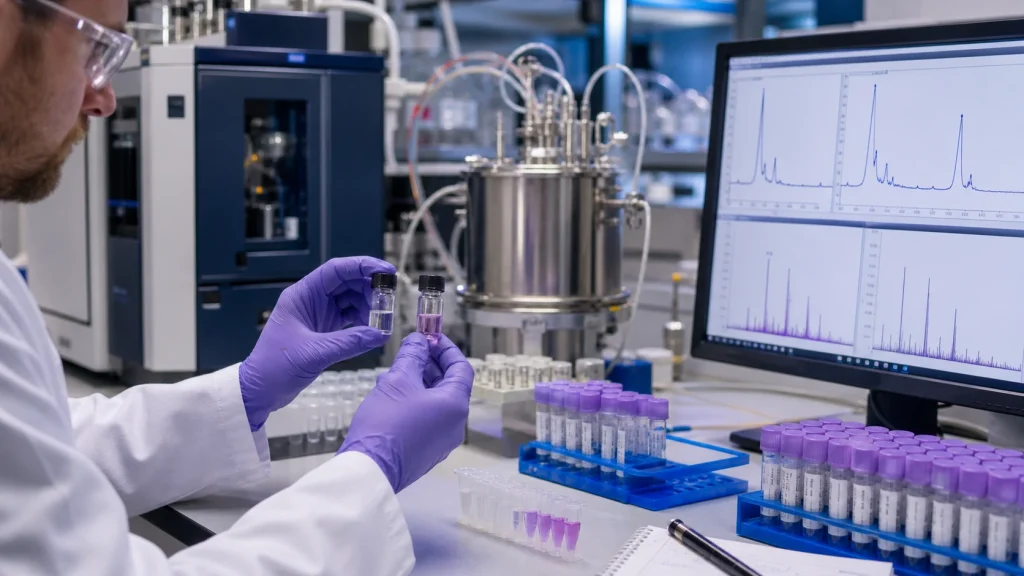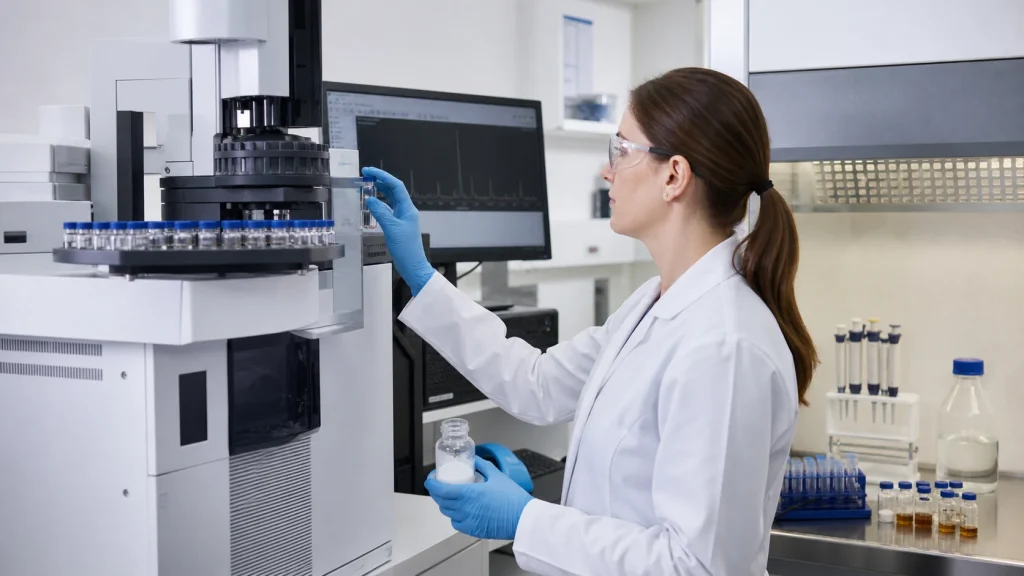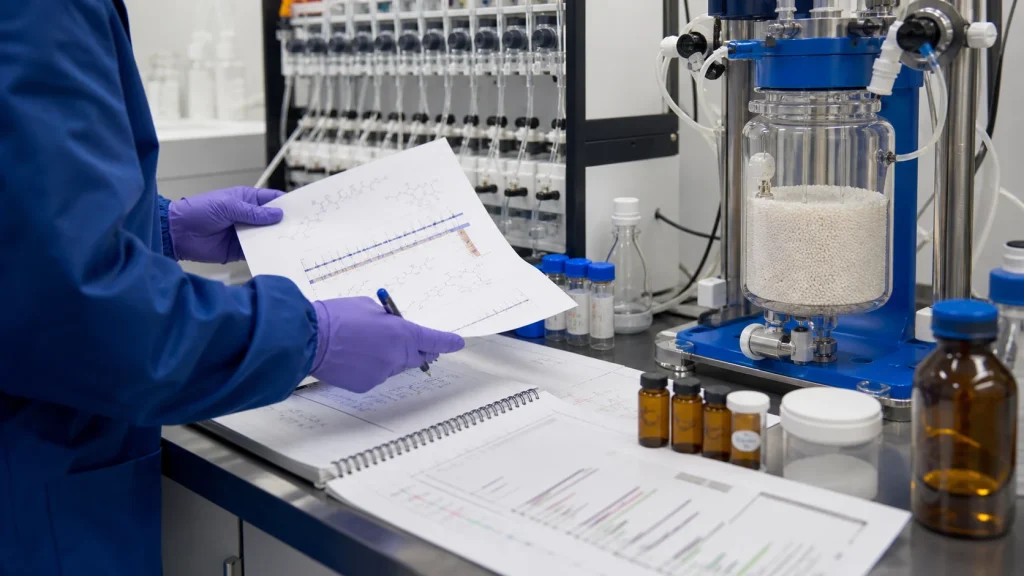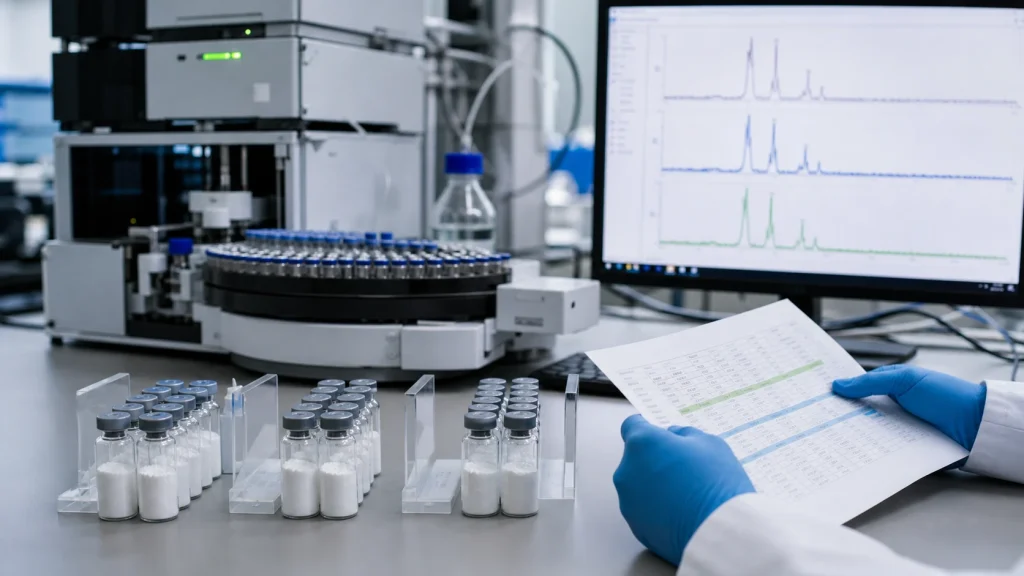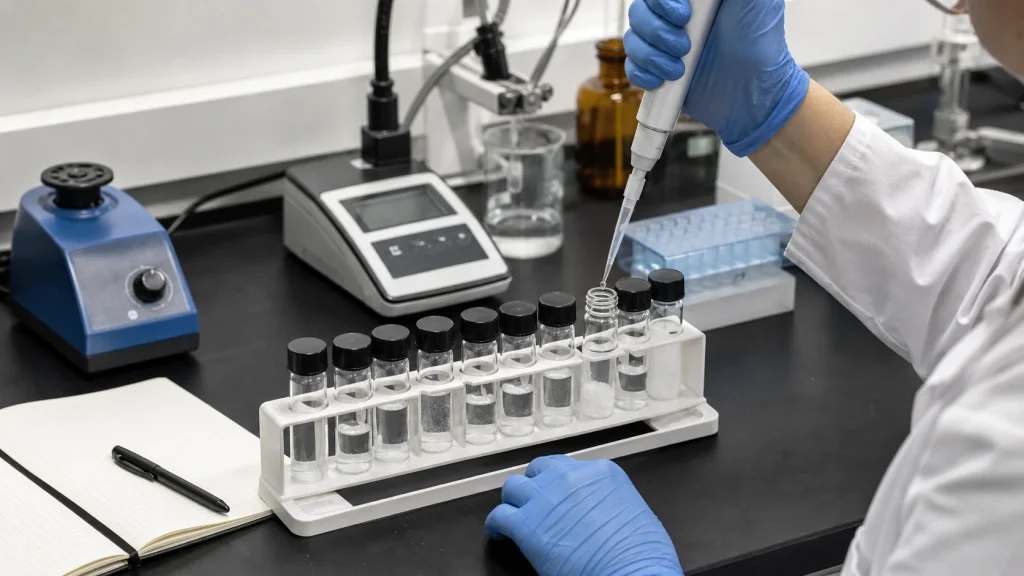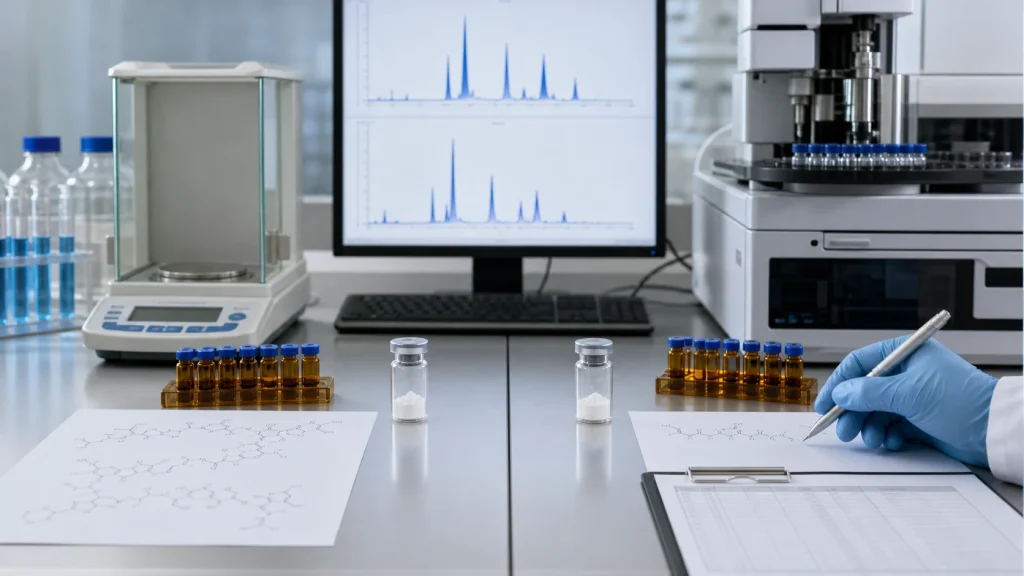
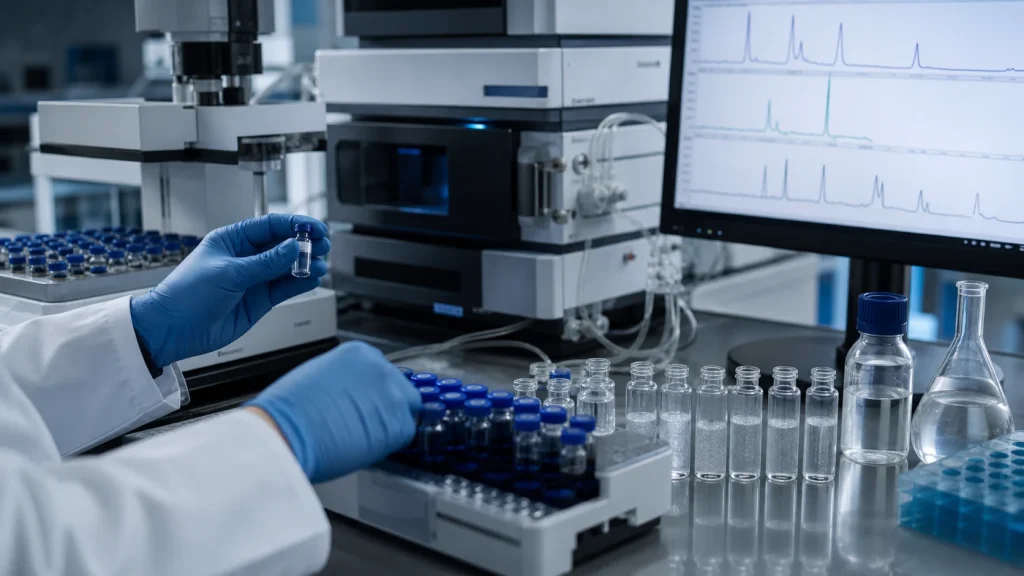
Lipidation improves hydrophobic character by design, but it also creates analytical behavior that short hydrophilic peptide methods do not predict. In lipidated GLP-1 peptide analytical method development, adsorption, aggregation, slow equilibration, carryover and incomplete recovery can produce a clean-looking chromatogram with the wrong answer. Retatrutide- and tirzepatide-class research materials therefore need molecule-suitable methods rather than a catalogue-wide gradient.
Begin with recovery, not resolution
Prepare replicate solutions in glass, standard polypropylene and low-bind vessels at the intended test concentration. Measure recovery over time. Include transfers, pipette tips and filters in the comparison. If peak area falls while impurity area does not rise, surface loss is more likely than chemical degradation.
Adsorption is concentration dependent. A method that recovers well at 1 mg/mL may fail at 20 µg/mL. Specify the validated range and avoid extrapolating below it. An internal standard can help reveal preparation loss, but only if it behaves similarly enough to the target.
Sample diluent determines what reaches the column
The diluent must dissolve the peptide, limit aggregation and remain compatible with the starting mobile phase. A strong organic diluent may keep the peptide soluble but distort peak shape on injection. A weak aqueous diluent may precipitate or adsorb the peptide before analysis. Screen organic proportion, pH, ionic strength and approved additives systematically.
Observe solutions immediately and after the maximum autosampler hold. Visual clarity is insufficient; use recovery and related-substance results. Mixing order matters. Adding concentrated buffer directly to a peptide stock can create a transient precipitation zone that does not fully reverse.
Control carryover explicitly
Lipidated peptides can remain on needle surfaces, valve pathways, tubing and columns. Inject blanks after high standards and samples. A generic wash may move the peptide from one surface to another without removing it. Develop needle and seal washes using solvents compatible with instrument materials and the peptide.
Set a numerical carryover criterion relative to the lower end of the analytical range. Alternate blank placement during validation to reveal cumulative buildup. If carryover changes after several batches, inspect hardware history and column conditioning rather than forcing the integration.
HPLC selectivity and column recovery
Stationary phase, pore size, temperature, gradient slope and ion-pairing conditions affect related-species separation. Run enough wash time to elute strongly retained material and enough re-equilibration to stabilize retention. A shortened high-throughput method can hide late impurities and generate retention drift.
Compare injected mass with recovered peak area using an appropriate reference. Guard columns and frits can adsorb material. Column temperature may sharpen peaks but also accelerate on-column change for unstable species. Document the compromise rather than optimizing only appearance.
Mass spectrometry has its own complications
Lipidated peptides show multiple charge states, adducts and sometimes broad envelopes. Deconvolution settings should be reported. Source conditions that reduce adducts can also fragment labile modifications. Review raw spectra as well as the deconvoluted mass.
Identity by mass does not prove modification site or sequence order. Peptide mapping or tandem MS may be needed for qualification and process-change lots. Sodium and potassium adducts are not automatically manufacturing impurities; investigate sample preparation and mobile phase before assigning them.
Aggregation is method dependent
Reversed-phase conditions can disrupt solution aggregates, so RP-HPLC purity does not describe the native sample state. Size-exclusion chromatography may help, but lipidated peptides can interact non-ideally with SEC columns. Dynamic light scattering detects larger populations but has limited specificity and is sensitive to dust. Use orthogonal methods with acknowledged limits.
Define the concentration, buffer and equilibration used for aggregate testing. Comparing suppliers under different matrices produces more argument than data. For batch trending, keep sample preparation and container history fixed.
A buyer-facing method package
- Sample diluent, vessel, concentration and hold-time recovery.
- Full HPLC gradient, column, temperature, wash and re-equilibration.
- Carryover study and cleaning procedure.
- System suitability for retention, efficiency, resolution and area precision.
- LC-MS charge-state and deconvolution information.
- Orthogonal aggregate or particle assessment where required.
Can a 99% result from one laboratory be compared with 98% from another? Not without method equivalence. Different recovery, integration and selectivity can explain the gap. Test a shared sample with both methods and compare impurity profiles before concluding that one batch is inferior.
When sourcing a lipidated GLP-family peptide, request method conditions and current-lot raw data before purchase. If the supplier cannot discuss adsorption, carryover or sample diluent, its high purity figure may reflect an easy chromatogram rather than a fully controlled measurement.