
A peptide oral film OEM specification needs to connect the finished unit to a defined composition, content measurement, disintegration endpoint and protective package. A smooth-looking strip can still have uneven peptide distribution or an unsuitable moisture response. Agree the material’s intended use and destination-market classification before turning a development sample into a commercial product brief.
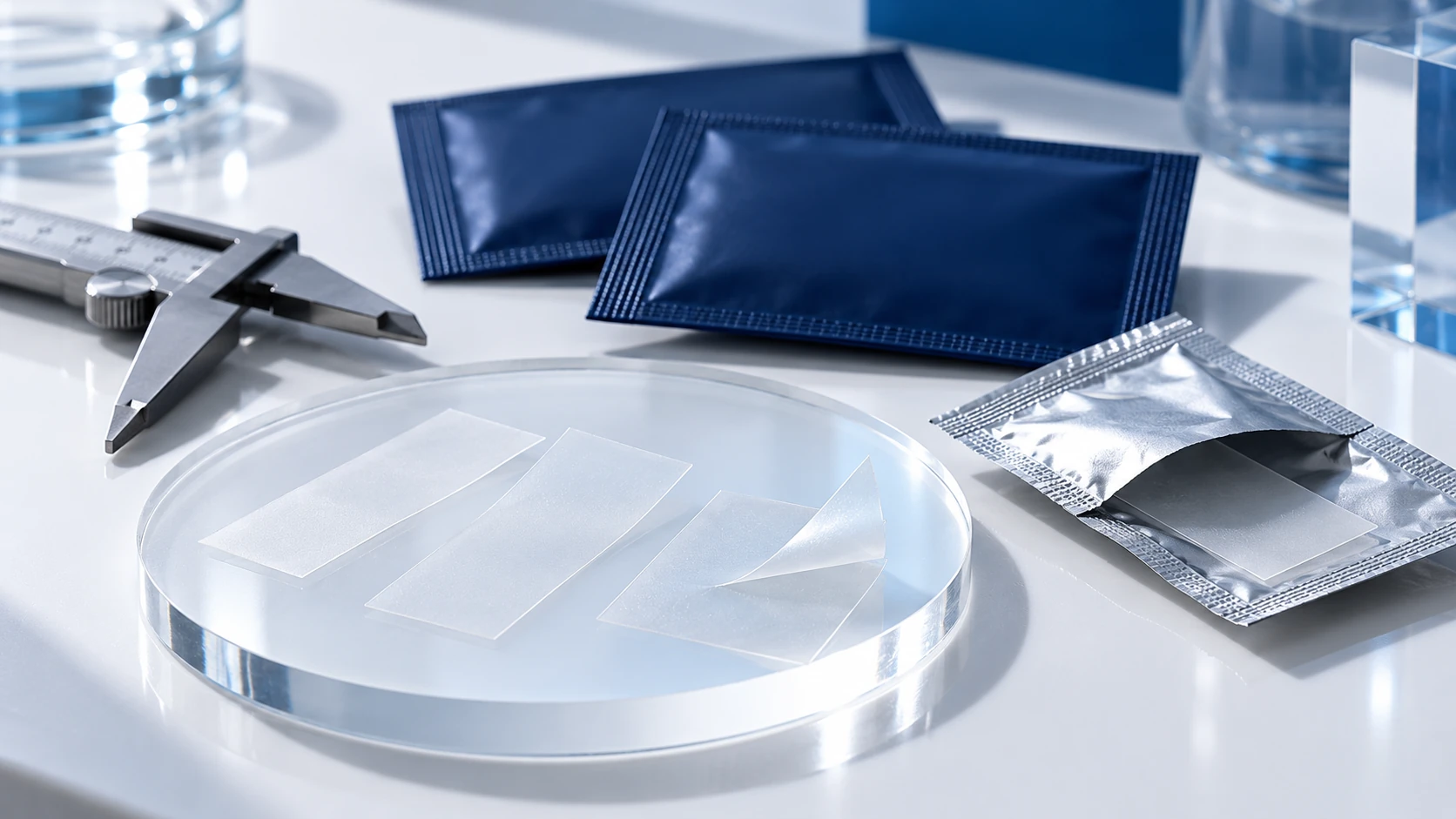
Separate the format from the intended use
“Oral film” describes a physical format. It does not establish a product’s regulatory category, suitability for oral use or biological availability. The formula, ingredients, claims and destination market determine the review required. A listing in a research peptide catalogue is not evidence that the material is suitable for an ingestible product.
Write the intended-use statement before selecting a development path. It should identify what the product is meant to do, which market will receive it and which party owns the classification decision. Medicinal claims require the appropriate development and authorization pathway. A purchasing team should not infer one from a film’s appearance or from its ability to disappear in liquid.
Measure peptide content across the web and within units
A cut strip’s mass is influenced by its dimensions, film thickness and composition. Consistent mass can support a process review, but it does not establish uniform peptide content. The peptide assay needs its own evidence for selectivity and recovery from the film matrix.
For a continuous web, request a sampling rationale covering relevant positions across its width and along the production run. Keep the samples’ locations attached to their results. A pooled composite can conceal a local problem when high and low results average together.
A geometry example
Consider a hypothetical film cut from a uniform web. Reducing a square from 2.0 cm per side to 1.8 cm changes its area from 4.0 to 3.24 cm², a 19% reduction. Even with perfectly uniform coating per unit area, the amount in the cut unit would change. This calculation is an illustration, not a proposed product specification.
Approve the dimensions and cutting tolerances alongside the assay requirements. Record whether rejected edge material or startup material is excluded from saleable units, and how that exclusion is controlled.
Define disintegration, dissolution and the endpoint observed
A strip can break apart before the peptide has been fully recovered in a test medium. It can also release peptide while leaving visible polymer residue. Disintegration and dissolution therefore need separate descriptions when both affect the product brief. State the apparatus, medium, agitation, temperature and endpoint in the method documentation.
Do not import a time limit from an unrelated dosage form. FDA’s December 2008 orally disintegrating tablet guidance discusses approximately 30 seconds or less for ODTs under its stated test context. It is guidance for tablets and is not a universal acceptance limit for oral films.
Require the development laboratory to explain why its film method discriminates between acceptable and unacceptable units. If two laboratories use different endpoints, their reported times may not be directly comparable. Neither result on its own establishes absorption or clinical performance.
Study handling and stability in the finished sachet
Film handling and packaging are linked. A strip that is easy to remove immediately after manufacture may become tacky or brittle during storage. Qualify the release liner, sachet and seal configuration used for the commercial samples, and record conditions before the pouch is opened.
| Question | Useful recorded result |
|---|---|
| Can the unit be removed intact? | Defined handling observations and unit rejection criteria |
| Does storage change its behaviour? | Content, relevant impurities, moisture response and physical observations over time |
| Does the seal protect the unit? | Package integrity evidence for the specified construction |
| Is microbial quality suitable? | Requirements and results appropriate to the product category and intended use |
Document the agreed storage conditions and review any package change against the stability work. A supplier’s general statement about the foil material does not characterize the complete sealed sachet.
Make the development sample reproducible at commercial scale
The transfer package should identify the approved composition, material grades, process revision, unit dimensions and analytical procedures. Describe which changes require customer approval. A small adjustment to a plasticizer, flavour component or drying process may affect handling and analytical extraction even when the principal peptide remains unchanged.
Specify who investigates an out-of-specification unit and what evidence the buyer receives. The manufacturing record should connect raw-material lots, production segments, cutting and packaging to the released film lot. That connection allows a result from a particular sample to be traced back to its manufacturing position.
ICH Q2(R2) is a pharmaceutical analytical-validation reference, not a universal legal requirement for every oral film category. Its emphasis on a procedure’s intended purpose is useful when discussing why a proposed film assay measures the property named in the specification.
Questions before an oral film OEM order
Does equal strip weight establish equal peptide content?
No. Mass and peptide content are different measurements. Confirm the peptide assay and a sampling design that can detect relevant variation within the film web and finished lot.
Must every oral film dissolve within 30 seconds?
No universal limit follows from FDA’s ODT guidance. That document addresses tablets. A film’s acceptance criterion needs a justified method, endpoint and intended-use context.
Does rapid dissolution prove peptide absorption?
No. A laboratory dissolution result describes performance under a defined test. Absorption and other biological claims require evidence designed to answer those separate questions.
Can a research peptide be used in a commercial oral film?
A research-material listing does not establish that suitability. The proposed ingredient, grade, intended use and destination-market category need a separate qualified review.
For a Hytanbio oral film development enquiry, send the intended market, ingredient identity, format objective and the evidence already available. The project team can discuss the development and documentation scope without treating a research material as an authorized finished product.