
A peptide microneedle patch OEM brief should define the array material, the intended peptide location and the evidence needed to release a packaged product. Dissolving arrays and PLA-based solid arrays require different specifications. Approving a sample because its tips look sharp leaves peptide distribution, moisture sensitivity and the behaviour of the finished format largely unanswered.
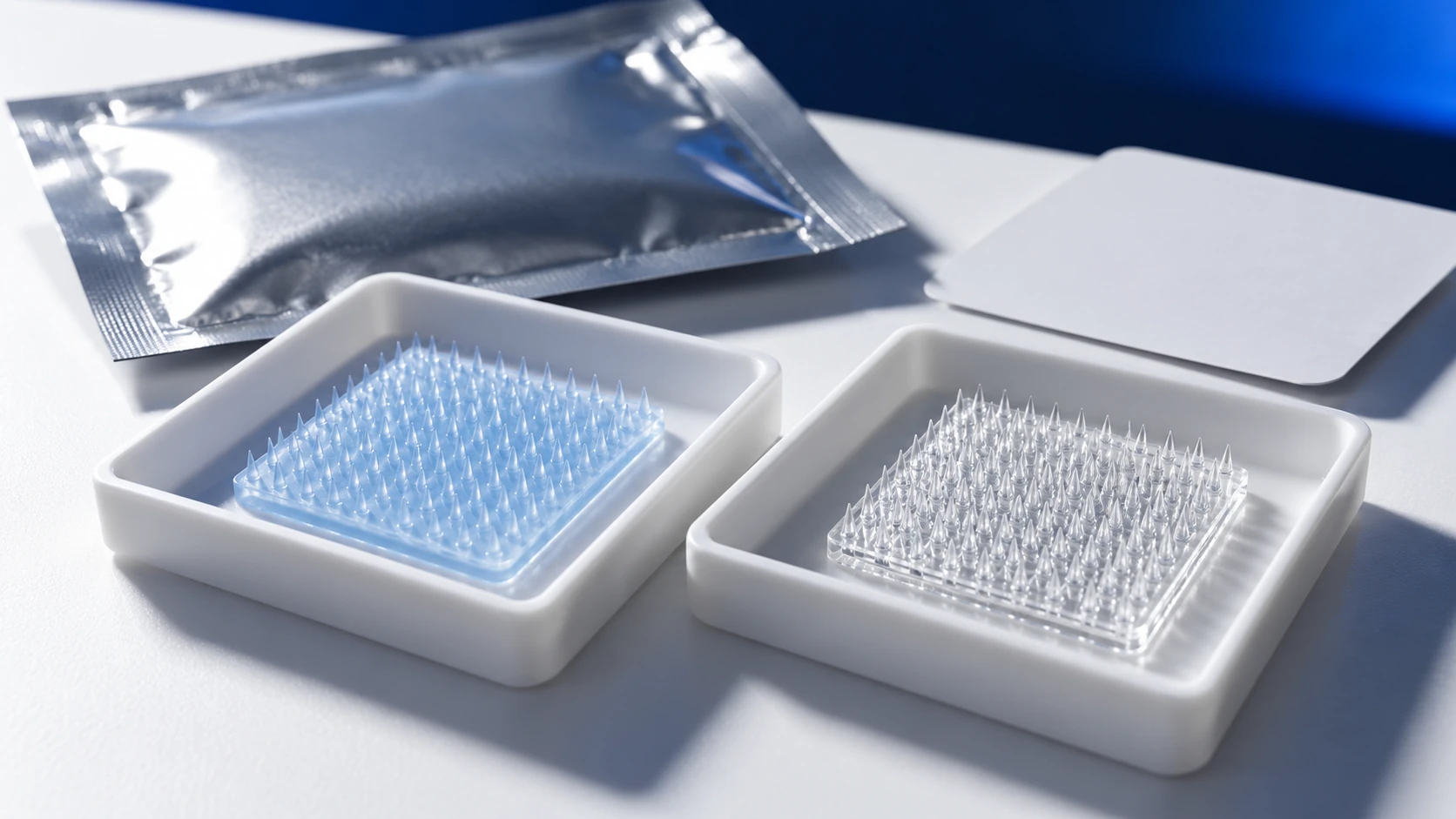
Choose the format before agreeing the product claim
A dissolving microneedle array uses a matrix intended to dissolve under its defined conditions of use. A solid PLA array has a different structural role. The polymer name alone does not establish how a finished device behaves, and “biodegradable” does not establish rapid dissolution during application.
The project brief should show where the peptide is intended to reside: within a dissolving matrix, in a separate formulation, or in another specifically developed arrangement. Ask the development team to document that design. A picture of the array cannot establish either the quantity of peptide present or its location.
For each proposed format, request an intended-use statement, a component description and a verification plan. Leave claims about delivery, clinical outcomes or treatment out of the purchasing specification unless the project has the evidence and regulatory pathway needed to support them.
Turn the array drawing into measurable acceptance criteria
A mould drawing is the starting point for inspection. It should connect each critical feature to a measurement method and an acceptance rule. Buyers need to know how the supplier detects missing, bent or malformed tips and how the packaged array is protected before use.
| Feature | Evidence to request |
|---|---|
| Array dimensions and tip geometry | Controlled drawing, measurement locations and inspection method |
| Tip defects | Defect categories, representative images and agreed sampling approach |
| Mechanical behaviour | Defined fixture, loading conditions, endpoint and result units |
| Backing and attachment | Construction specification and relevant attachment testing |
A force result without its fixture and endpoint is difficult to compare between laboratories. Likewise, an insertion result on one test substrate does not automatically establish performance in human skin. Keep laboratory verification and clinical claims as separate evidence questions.
Account for peptide location and recoverable content
An assay of the entire patch can answer a different question from an assay of the microstructured region. If peptide remains in a backing layer or another component, a whole-unit result can hide a distribution problem. Specify the component or region represented by the result, along with the analytical recovery evidence.
The laboratory also needs a matrix blank. Polymer, adhesive or backing extract can interfere with the peptide measurement or reduce extraction recovery. An HPLC peak at an expected retention time is insufficient on its own when the matrix contributes a nearby signal.
Ask for the tested units’ positions within the manufacturing lot, the sample-preparation rationale and the method’s ability to distinguish the intended peptide from relevant degradation products. For a dissolution-related test, record what endpoint is observed. A change in tip appearance is not a measurement of retained peptide identity.
Qualify the patch inside its proposed packaging
Review the pouch, tray, liner and any desiccant as part of the product configuration. Protection during distribution matters because a damaged array may still have an acceptable whole-unit assay. Moisture exposure can also alter the handling of some dissolving matrices before a user opens the pouch.
- Link stability samples to the final pouch material and sealing process.
- Check array condition after justified distribution and storage challenges.
- Record peelability, liner removal and visible residue with defined observations.
- Distinguish routine microbial quality requirements from a claim of sterility.
Define which changes trigger requalification. A new pouch laminate, backing adhesive or mould revision can affect a previously qualified product. The supplier’s change notice should identify the affected component and the evidence supporting continued use, rather than simply stating that the product remains equivalent.
Review certification scope and the destination-market pathway
ISO 13485:2016 concerns quality management systems for medical devices. When evaluating a certificate, check the legal entity, manufacturing site and certified activity. A company certificate does not establish approval for every patch design or claim in its catalogue.
In the United States, FDA’s microneedling product guidance addresses when a product meets the medical-device definition. FDA also describes limits on the authorized uses of microneedling devices. These sources should not be treated as a blanket authorization for peptide-loaded dissolving patches.
Have the responsible regulatory reviewer evaluate the actual configuration, intended use and claims for each destination market. A universal needle-length threshold copied from another product is an inadequate basis for that decision.
Questions for a microneedle OEM review
Are dissolving arrays and PLA solid arrays interchangeable?
No. They have different structural roles and require configuration-specific verification. Define the material, peptide location and intended product behaviour before comparing OEM quotations.
Does a good whole-patch assay prove that the tips contain the intended amount?
Only if the assay and sampling design establish that relationship. Ask which part of the patch was tested and whether extraction recovery and within-unit distribution were evaluated.
Does ISO 13485 certification mean that a patch is FDA approved?
No. Quality-system certification and product-specific market authorization answer different questions. Check the certificate’s scope and the evidence for the individual product and its claims.
What should accompany an initial OEM enquiry?
Provide the destination market, proposed format, peptide identity, intended claims, packaging concept and the verification work already completed. Avoid committing to mould tooling while these decisions remain unresolved.
Hytanbio’s microneedle development and manufacturing overview covers dissolving patches and PLA-based solid formats. Send a project brief to discuss the format and documentation scope before sampling.