
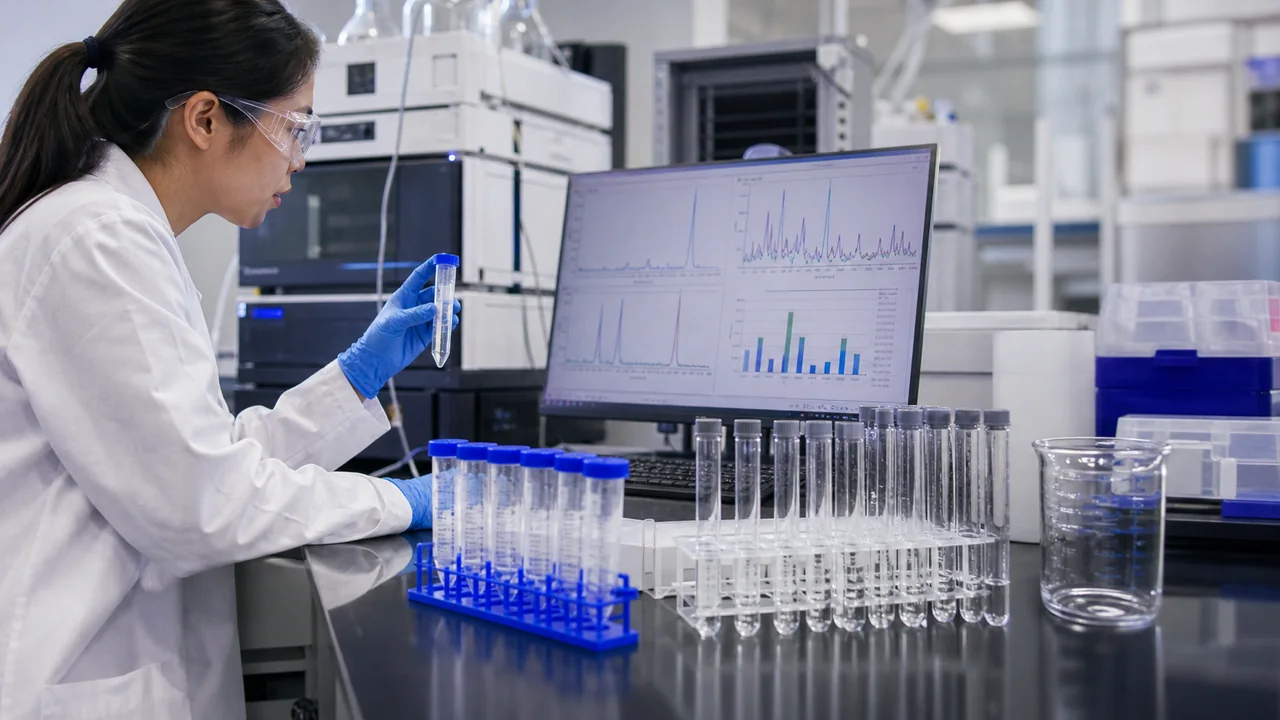
An unexpectedly low peptide result is not always degradation or under-filling. At low concentrations, loss to the vial, tube, pipette tip or filter can dominate the mass balance.
Why surface loss is peptide-specific
Adsorption is governed by sequence, net charge, hydrophobicity, concentration, pH, ionic strength and the chemistry and history of the contact surface. Published recovery experiments show that changing glass or plastic can materially change measured peptide recovery; “low-bind” is therefore a hypothesis to verify, not a universal property.
A recovery study that answers the question
Prepare one homogeneous stock and distribute it across candidate containers at the intended concentration. Include time-zero and transfer controls, relevant hold times, surface-to-volume ratios and enough replicates to estimate variability. Analyse the same solution after zero, one and multiple transfers. A concentration series is particularly informative because fractional loss commonly becomes more visible near the lower end of a method range.
Interpreting the result
Separate adsorption from precipitation and chemical degradation. Loss from solution with no new stability-indicating peaks suggests a mass-balance problem, but confirmation may require extraction of the contacted surface or comparison with a non-contact control. A surfactant, carrier protein or organic modifier may improve recovery, yet each can alter chromatography or MS response and must be justified for the intended method.
Decision Table
| Variable | What to hold constant | What to measure |
|---|---|---|
| Container | Supplier, resin/glass type, lot and fill volume | Initial and time-dependent recovery |
| Transfers | Tip type, number of transfers, mixing | Cumulative recovery loss |
| Solution | pH, ionic strength, organic fraction | Recovery and impurity profile |
| Concentration | Cover actual method range | Bias and precision by level |
What Belongs in the Procurement File
The purchasing specification should name the material form, intended analytical use, methods, acceptance criteria, sample and lot identifiers, packaging, storage and change-notification requirements. The receiving record should reconcile those requirements with the vial, COA, raw or controlled analytical output and shipping history. For the broader framework, consult the 2026 wholesale buyer’s guide, the HPLC review and the mass-spectrometry review.
Frequently Asked Questions
Is polypropylene always better than glass?
No. Recovery is peptide- and condition-specific; qualify the actual container and concentration.
Can adsorption cause a passing HPLC purity result?
Yes. Purity is relative peak area and may remain high while absolute recovery is low.
Technical Reference
Primary or authoritative reference used for this article. Its findings should be applied only within the material, formulation and method conditions described.