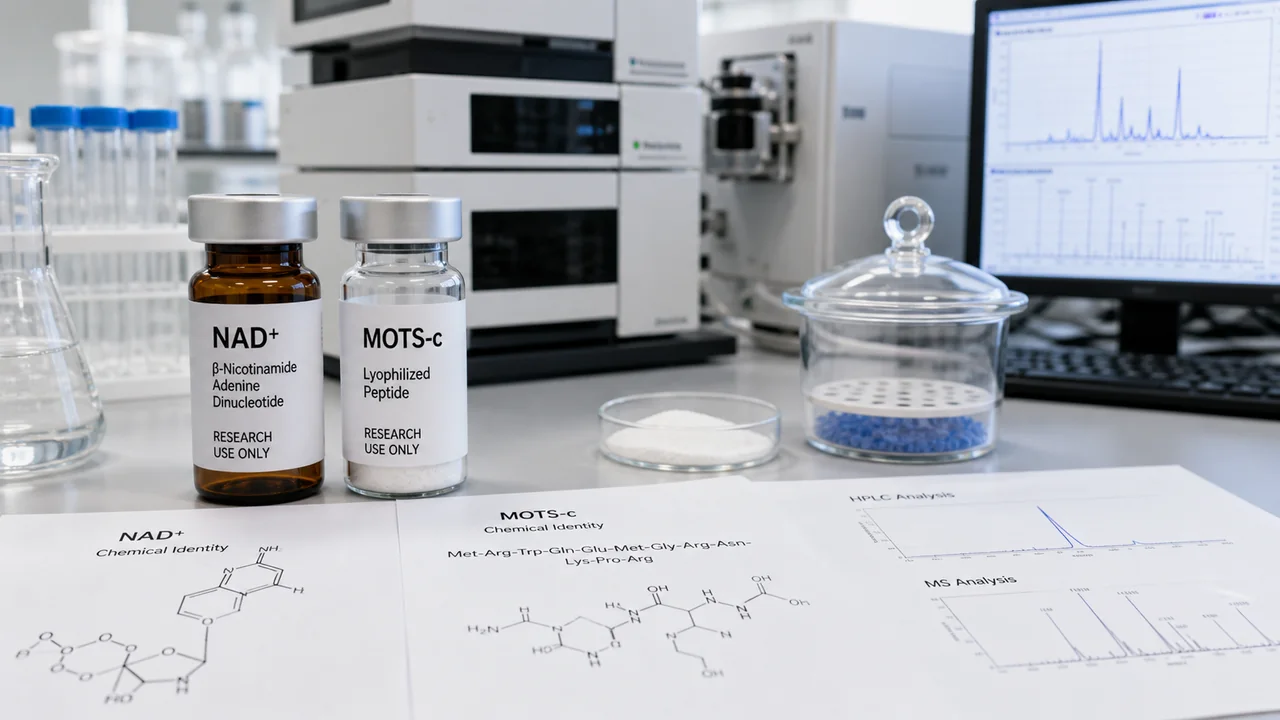
Quick answer: Searches for NAD+ vs MOTS-c research material often treat related names as interchangeable. They are not. The correct comparison starts with exact chemical identity, sequence or material class, then reviews compound-specific HPLC, mass spectrometry, storage and batch records.
Nad+ Vs Mots-C Research Material: Key Differences
| Material | Primary distinction | Buyer verification |
|---|---|---|
| NAD+ | Small-molecule coenzyme, not a peptide | Identity/assay, water content and packaging |
| MOTS-c | Peptide with defined amino-acid sequence | Sequence-specific MS and HPLC evidence |
| Comparison | Different chemistry requires different methods | Do not compare one purity number directly |
How to Compare Identity and Purity
Write the exact material name, sequence, terminal modifications, counter-ion or salt form and reporting basis into the purchase specification. A product label is not identity evidence. Mass spectrometry should show an assignment consistent with the expected molecular species, while HPLC should be reviewed with its method, chromatogram, integration and related peaks.
HPLC area percentage is method-dependent and is not automatically equivalent to assay, net peptide content or purity obtained with another method. The supplier should connect the raw analytical record, COA and shipped vial through the same sample and lot identifiers.
Storage, Solubility and Batch Consistency
Do not copy storage or reconstitution conditions from a related product. Sequence, concentration, solvent, pH, container surface, moisture, light and temperature can change recovery and stability. Define an approved laboratory method, small aliquots where justified, a freeze-thaw record and a material-specific hold-time study.
For wholesale qualification, compare several representative lots. Trend the chromatographic profile, identity result, water or moisture context, appearance, packaging and deviations. Require advance notice when synthesis, purification, analytical method, site or primary container changes.
Wholesale Supplier and COA Checklist
- Confirm the supplier’s role: manufacturer, CDMO, distributor or trading company.
- Match product, lot, sample ID and dates across the COA, HPLC/MS report, label and packing list.
- Verify third-party reports through independently obtained laboratory contact details.
- Approve packaging, storage, shipping and temperature-excursion rules before dispatch.
- Keep every description aligned with Research Use Only laboratory purposes.
View the related product record. View the related product record. Continue with the 2026 wholesale buyer’s guide, HPLC review guide and MS identity guide.
Frequently Asked Questions
What is the main difference in NAD+ vs MOTS-c research material?
The materials have different chemical identities, sequences or molecular classes. Buyers should compare compound-specific evidence rather than one headline purity value.
Can the same HPLC method be used for both materials?
Not automatically. Method suitability depends on the analyte, impurity profile, column, mobile phase, detection and integration rules.
Which documents should a wholesale buyer request?
Request the approved specification, lot COA, raw or controlled HPLC/MS evidence, SDS or hazard information, label, packaging and storage records.