
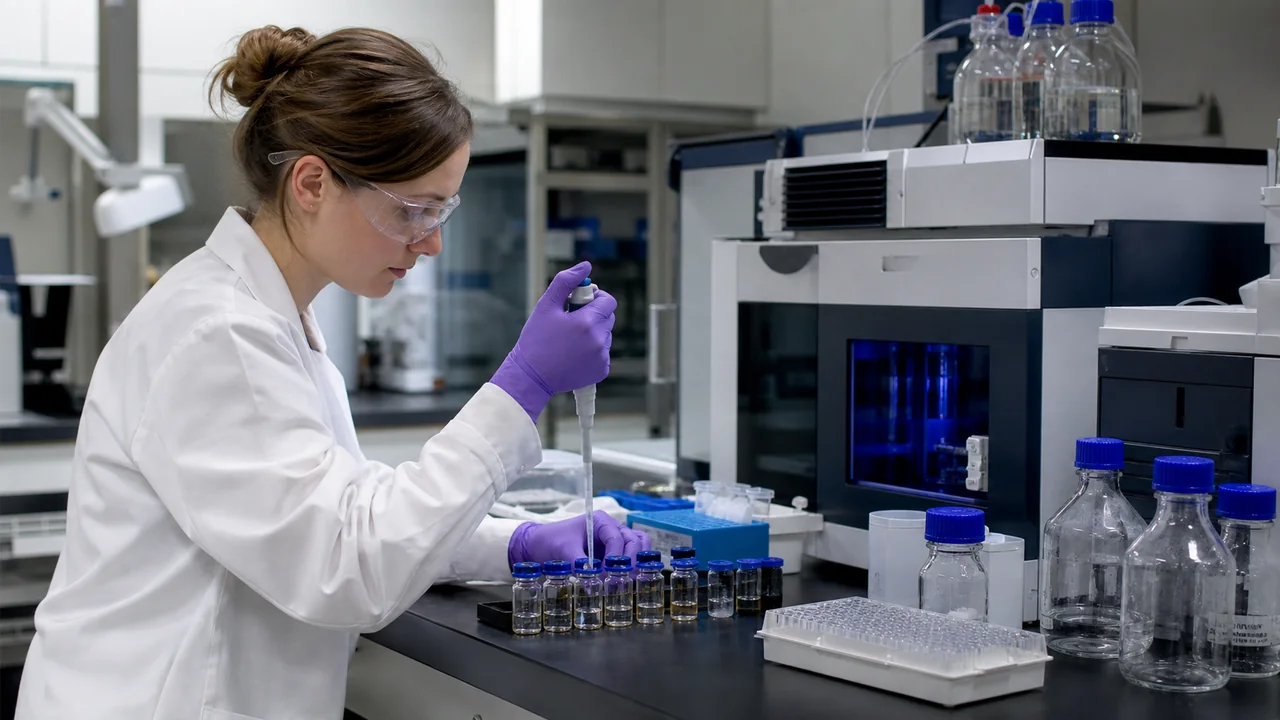
“Clear after mixing” is not a solubility result. A defensible method distinguishes true dissolution from suspended particles, adsorption, chemical conversion and incomplete recovery.
Use sequence information to frame experiments
Charge distribution, hydrophobic residues, terminal groups, counter-ion and modifications inform likely pH and solvent behaviour, but prediction does not replace measurement. Begin at small scale with a documented stock and a solvent matrix appropriate to the downstream analytical technique.
Screen one variable at a time, then confirm interactions
Evaluate concentration, pH, ionic strength, organic co-solvent, mixing energy, time, temperature and container. Include solvent blanks and filtration/centrifugation controls. A filter can remove undissolved material and adsorb dissolved peptide simultaneously, so determine filter recovery rather than assuming it.
Close the mass balance
Measure the supernatant and, where feasible, extract the container, filter or pellet. Monitor chemical integrity with a stability-indicating method because improved apparent recovery can accompany degradation. The selected procedure should define preparation order, acceptable appearance, recovery, hold time and compatibility with HPLC or MS.
Decision Table
| Experiment | Response | Hidden risk |
|---|---|---|
| pH screen | Recovery and impurity profile | pH-driven degradation |
| Co-solvent screen | Dissolved concentration | Detector/ionisation interference |
| Container study | Time-dependent recovery | Surface adsorption |
| Filter study | Filtrate plus extract recovery | Membrane binding |
| Hold-time study | Recovery and related peaks | Slow precipitation or conversion |
What Belongs in the Procurement File
The purchasing specification should name the material form, intended analytical use, methods, acceptance criteria, sample and lot identifiers, packaging, storage and change-notification requirements. The receiving record should reconcile those requirements with the vial, COA, raw or controlled analytical output and shipping history. For the broader framework, consult the 2026 wholesale buyer’s guide, the HPLC review and the mass-spectrometry review.
Frequently Asked Questions
Does visible clarity prove complete dissolution?
No. Concentration can be below saturation while substantial material remains adsorbed or chemically changed.
Should DMSO be used for every difficult peptide?
No. Solvent choice must consider stability, intended concentration, downstream method and safety.
Technical Reference
Primary or authoritative reference used for this article. Its findings should be applied only within the material, formulation and method conditions described.