
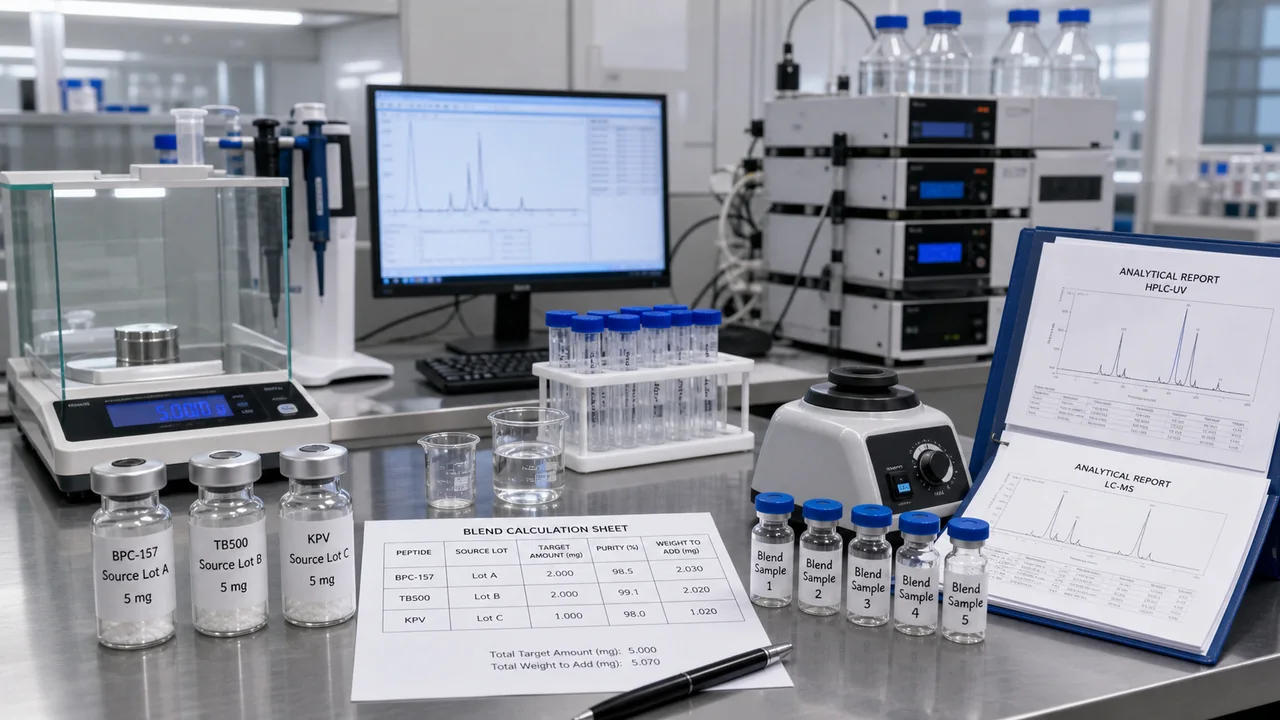
Quick answer: The key search question—BPC-157 TB500 KPV blend quality control—cannot be answered by product name or a single “99%” claim. Buyers should identify the exact chemical form and lot, choose a suitable method, review raw evidence and separate identity, chromatographic purity, quantitative content, moisture, counter-ion and packaging controls.
Bpc-157 Tb500 Kpv Blend Quality Control: Comparison Table
| Item | What it means | Buyer check |
|---|---|---|
| Source materials | Three distinct components | Individual source-lot COAs and identity |
| Blend ratio | Nominal label ratio is not proof | Calculation, weighing and reconciliation |
| Finished blend | Sampling and homogeneity matter | Component-resolving method and stability plan |
Analytical Review: COA, HPLC and Mass Spectrometry
Match the sample and lot identifiers across the vial, COA, chromatogram, spectrum and packing list. HPLC area percentage is method-dependent; it does not automatically equal assay or net peptide content. MS supports molecular identity but does not by itself quantify every impurity, water, counter-ion or residual solvent.
Ask for method conditions, system suitability or controls where applicable, integration, raw or controlled exports and the reporting basis. Trend multiple lots using comparable methods instead of relying on one showcase report.
Storage, Packaging and Batch Consistency
Material stability depends on sequence or chemical class, formulation, moisture, solvent, pH, concentration, container, light, oxygen and temperature. Qualify storage and hold time for the exact material. Inspect closure integrity and shipping records at receipt, quarantine discrepancies and document each freeze-thaw event for solutions.
Wholesale Procurement Checklist
- Define exact name, sequence/form, counter-ion and reporting basis.
- Approve tests, specifications, sampling and packaging before ordering.
- Verify manufacturer, testing laboratory and chain of custody.
- Compare representative lots and investigate meaningful trends.
- Keep label, invoice and website language strictly Research Use Only.
Related product. Related product. Related product. Read the complete wholesale buyer’s guide, HPLC guide and MS guide.
Frequently Asked Questions
What is the short answer for BPC-157 TB500 KPV blend quality control?
Define the exact material and question first, then use a method and specification suited to that material. One headline purity value cannot answer identity, content, moisture and packaging questions.
Can results from different laboratories be compared directly?
Only after confirming comparable samples, methods, reporting bases, integration rules and measurement uncertainty where relevant.
What should a wholesale buyer retain?
Retain the specification, lot COA, raw or controlled analytical evidence, label, packaging, storage, shipping and deviation records.