
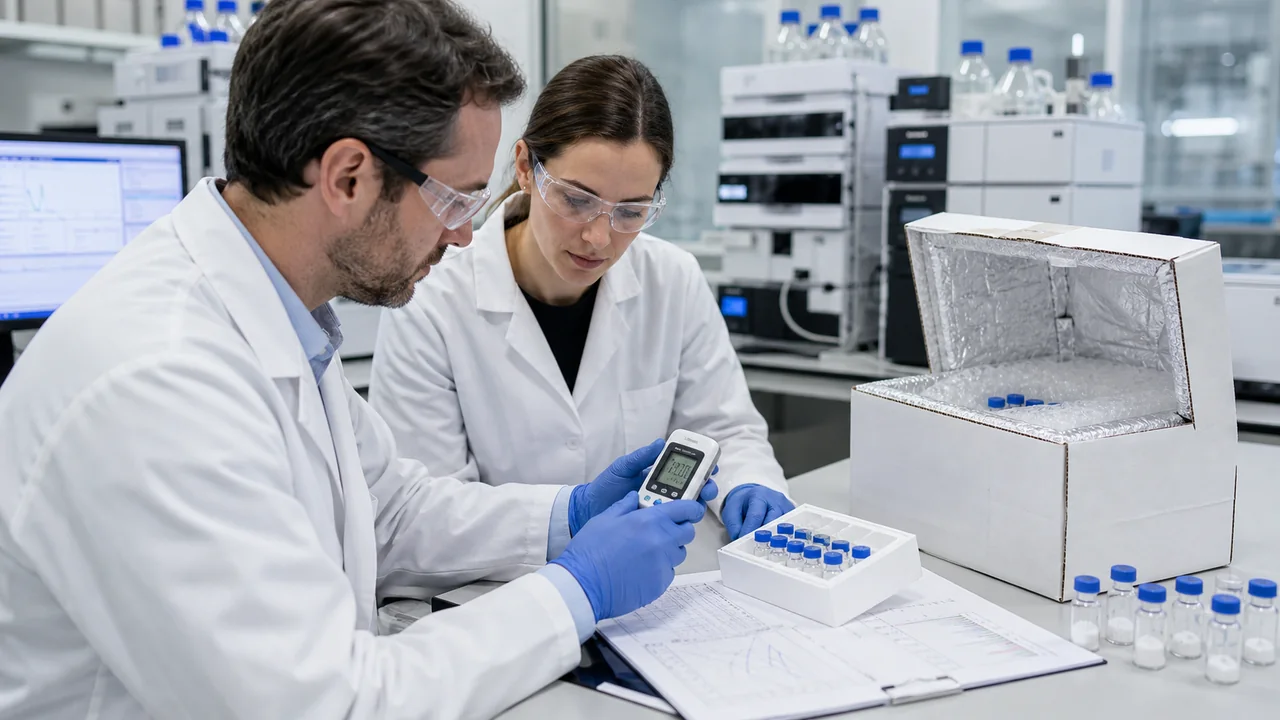
A warm logger does not automatically condemn a lyophilised peptide, and a cold package does not automatically release it. The decision must connect calibrated time-temperature data with product-specific stability evidence.
Quarantine first, interpret second
Place affected units under the labelled storage condition and block use. Preserve the logger file, calibration status, time zone, pack-out record, shipment events, vial condition and the exact duration outside limits. Do not reset or summarise away the raw trace.
Translate the trace into product exposure
Distinguish air, coolant and product-proxy temperature. Note logger placement and response lag. Compare the excursion with stability studies for the same formulation, container, moisture range and quality attributes. Lyophilised and reconstituted materials require separate assessments.
Make a documented quality decision
The assessment should identify worst-case units, cumulative prior excursions, relevant degradation pathways and whether targeted testing can reduce uncertainty. HPLC alone may miss moisture, aggregation or potency changes. Release, additional testing, shortened retest, or rejection should follow predefined authority and rationale—not commercial urgency.
Decision Table
| Evidence | Question | Decision value |
|---|---|---|
| Raw logger file | What exposure actually occurred? | Time-temperature profile |
| Calibration | Was the measurement reliable? | Measurement confidence |
| Stability data | Does it represent this formulation? | Scientific bridge |
| Package inspection | Was barrier/closure compromised? | Additional ingress risk |
| Analytical testing | Can relevant change be detected? | Residual uncertainty |
What Belongs in the Procurement File
The purchasing specification should name the material form, intended analytical use, methods, acceptance criteria, sample and lot identifiers, packaging, storage and change-notification requirements. The receiving record should reconcile those requirements with the vial, COA, raw or controlled analytical output and shipping history. For the broader framework, consult the 2026 wholesale buyer’s guide, the HPLC review and the mass-spectrometry review.
Frequently Asked Questions
Is a brief ambient excursion always acceptable for lyophilised peptide?
No universal duration applies. Use product- and package-specific evidence.
Can retesting erase an excursion?
No. Testing can inform the decision but cannot reconstruct every stability attribute or future risk.
Technical Reference
Primary or authoritative reference used for this article. Its findings should be applied only within the material, formulation and method conditions described.