
Research Use Only (RUO). This article addresses analytical qualification and B2B procurement of KPV laboratory material. It does not cover dosing, administration, or therapeutic use.
Quick answer: what should a KPV purchase specification contain?
A defensible KPV specification starts with the exact molecular form, not the three-letter name. State the sequence as H-Lys-Pro-Val-OH, identify the counter-ion, and define whether the quoted quantity is gross lyophilized material or net peptide content. Require a batch-linked HPLC chromatogram, an LC-MS spectrum consistent with the specified form, water content, appearance, fill or bulk net weight, and the supplier’s sampling rule. For a large order, approve a representative pre-shipment sample and reserve the right to test production containers rather than a separate showcase vial.
That sounds elementary. In practice, it prevents most KPV disputes I see. A polished certificate can report 99% chromatographic purity while leaving the buyer uncertain about salt form, actual peptide mass, residual water, and whether the tested sample came from the material being shipped.
Lock the molecular form before comparing quotations
KPV is the tripeptide Lys-Pro-Val. The free-acid form H-Lys-Pro-Val-OH has the formula C16H30N4O4 and an average molecular mass of 342.43 g/mol. Acetate adds counter-ion mass; it does not change the active peptide sequence, but it does change the relationship between weighed material and peptide content. The FDA’s 2026 KPV background material lists 342.43 g/mol for the free base and approximately 402.5 g/mol for the acetate combination. A quotation that says only “KPV 99%” is therefore incomplete.
Ask the supplier to put five identity fields on the specification and COA: full sequence, terminal groups, stereochemistry, salt or counter-ion, and theoretical molecular mass. The CAS number is useful for document matching, but it cannot substitute for these fields. The same CAS number is sometimes used in commercial paperwork for both free-base and acetate descriptions.
This is also where a mass-spectrum mismatch often starts. A buyer expects the free-acid mass, while the supplier discusses a salt-associated material or reports an ion/adduct without explaining charge state. The raw spectrum should label the observed ion, calculated ion, charge, and acceptable mass error. “MS conforms” on a one-page COA is not enough evidence for an incoming-material investigation.
Read the HPLC method, not just the purity percentage
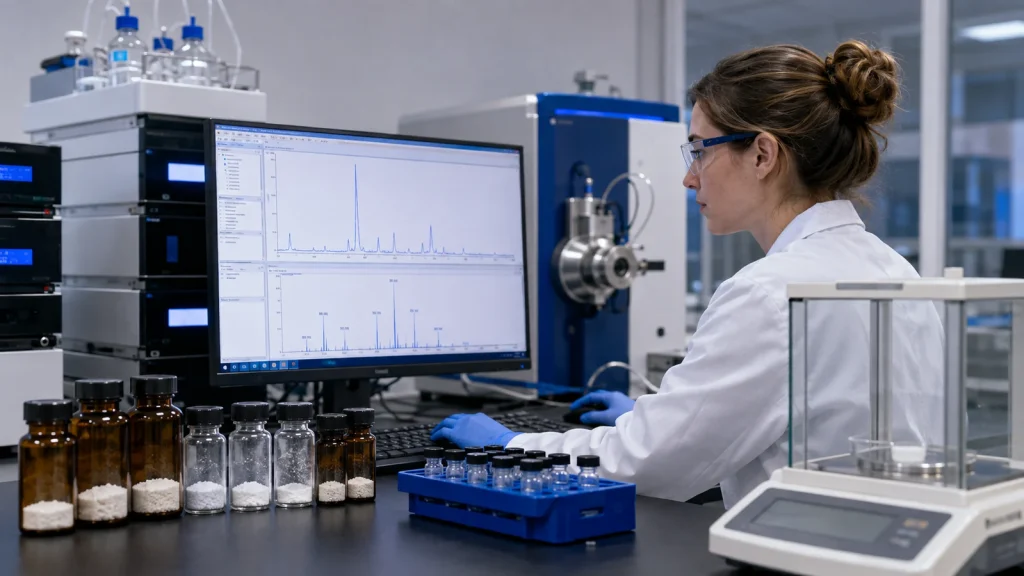
KPV contains no aromatic residue, so its UV response is strongest at low wavelength. A credible reversed-phase HPLC report normally states the detection wavelength, column, mobile phases, gradient, flow rate, injection amount, and integration rules. If the certificate reports only a peak-area percentage, request the full chromatogram and method page.
Low-wavelength detection is sensitive but unforgiving. Solvent fronts, trifluoroacetate-related signals, baseline disturbance, and mobile-phase contaminants can complicate integration. Conversely, an aggressive integration threshold can make small impurity peaks disappear. A 99.4% result from one method is not automatically superior to 99.0% from another method. Compare chromatographic conditions, peak shape, retention behavior, baseline resolution, and excluded peaks before comparing the headline number.
A published stability-indicating KPV assay used reversed-phase C18 chromatography with water/acetonitrile mobile phases containing 0.1% TFA. That method is evidence that degradation can be separated and monitored under defined conditions; it does not mean every supplier’s release method is stability-indicating. Ask whether forced-degradation samples were used to demonstrate specificity. If not, the assay may show area purity without proving that the main degradants are resolved from KPV.
HPLC purity, identity, and content answer different questions
HPLC area purity estimates the relative UV-detected composition under one method. LC-MS supports molecular identity. Neither measurement, by itself, tells you how many milligrams of KPV are present in a gram of hygroscopic or salt-containing powder.
For bulk procurement, add a peptide-content test. Amino acid analysis can quantify constituent amino acids after hydrolysis; quantitative NMR can provide an orthogonal mass-balance result when a suitable reference and validated procedure are used. Each method has limitations. Amino acid analysis loses sequence information and depends on hydrolysis recovery. qNMR depends on solubility, signal selection, reference traceability, and water or counter-ion accounting. The practical approach is to define one release method and use an orthogonal method during supplier qualification or periodic surveillance.
Moisture matters disproportionately in a small peptide. Karl Fischer water, residual solvents, counter-ion level, and inorganic residue all affect the gap between gross powder weight and net KPV content. If material will be divided into vials, specify whether the fill target is based on total powder, free-peptide equivalent, or acetate material. Otherwise a bulk lot may pass HPLC and still produce inconsistent apparent fills after subdivision.
Sampling is the weak point in many third-party COAs
The laboratory report should identify the client, sample description, lot number, test date, methods, and report-verification route. Those details prove what the laboratory received; they do not prove who collected the sample or whether it represents the whole production lot.
Before approving a bulk KPV peptide supplier, map the chain of custody. Was the sample drawn from the finished homogenized bulk? How many containers were included? Was it collected before or after final drying? Are production, COA, packing-list, and vial-label lot numbers identical? A supplier-submitted sample may be acceptable, but its limitation should be recorded. For a high-value order, use your own random sampling at receipt or appoint an independent inspector.
One recurring failure is a clean pre-shipment vial followed by lower and more variable results across delivered containers. Another is a COA copied forward after the supplier blends or re-dries material. A retained sample, container map, and written change-control requirement make these discrepancies investigable.
Packaging, temperature, and receipt checks
Lyophilized material should arrive sealed, dry, protected from light, and labeled with an unambiguous lot number. Define storage conditions from supplier stability data rather than repeating a generic peptide rule. Temperature logging is useful when the shipment route is long, but it cannot replace stability evidence. A brief excursion and prolonged moisture exposure are different risks.
At receipt, photograph seals and labels, reconcile weights, inspect cake or powder appearance, and quarantine the lot until identity and agreed critical tests pass. If the material is distributed across many vials, sample early, middle, and late filling positions when feasible. This catches segregation or fill drift that a single composite result can hide.
Clarify logistics charges before issuing the purchase order. Cold packs, temperature loggers, insulated boxes, dangerous-goods declarations, customs brokerage, and replacement-shipment terms are often priced separately. A low unit price can become the most expensive offer once these hidden charges and re-testing costs are added.
Questions to send before requesting a sample
- What exact KPV form, terminal groups, counter-ion, and theoretical mass will be supplied?
- Is the stated quantity gross material or net KPV peptide content?
- Can you provide the complete HPLC method, chromatogram, integration table, and LC-MS spectrum?
- Which tests are performed on every lot, and which are qualification-only?
- How is the third-party sample drawn, sealed, and linked to the production batch?
- What are the container-level homogeneity, storage, excursion, and re-test policies?
- Will the same specification apply to the approval sample and scale order?
The best supplier response is not a larger marketing packet. It is a coherent set of batch records in which identity, purity, content, sampling, packaging, and logistics refer to the same material. If you are comparing KPV bulk formats, send the intended analytical specification and pack configuration with your inquiry; that gives a technical team enough information to flag salt-form or testing differences before quotation.